
Your Second Street Kart Ride in Tokyo: Comparing How the City Looks in the Morning and in the Evening
Your Second Street Kart Ride in Tokyo: Comparing How the City Looks in the Morning and in the Evening
How much do you remember from your first street kart ride? The Shibuya crossing. Waves of people streaming across in front of you. The weight of the steering wheel in your hands. But let's be honest: wasn't most of that memory taken up by "keeping up with the kart in front"?
The second time is different! You already know how the tour works, so your eyes drift up just a little. Then change the time of day, and the same Tokyo streets start to look like a completely different city. So let's go one more time.
The first time, you're busy just keeping up. The second time, you have room to notice the light
Think back to your first ride. You listened to the pre-departure briefing in English, your heart raced at every traffic light, and you probably kept your eyes fixed ahead so you wouldn't miss your lead guide's signals. That's perfectly fine. Everyone is like that the first time.
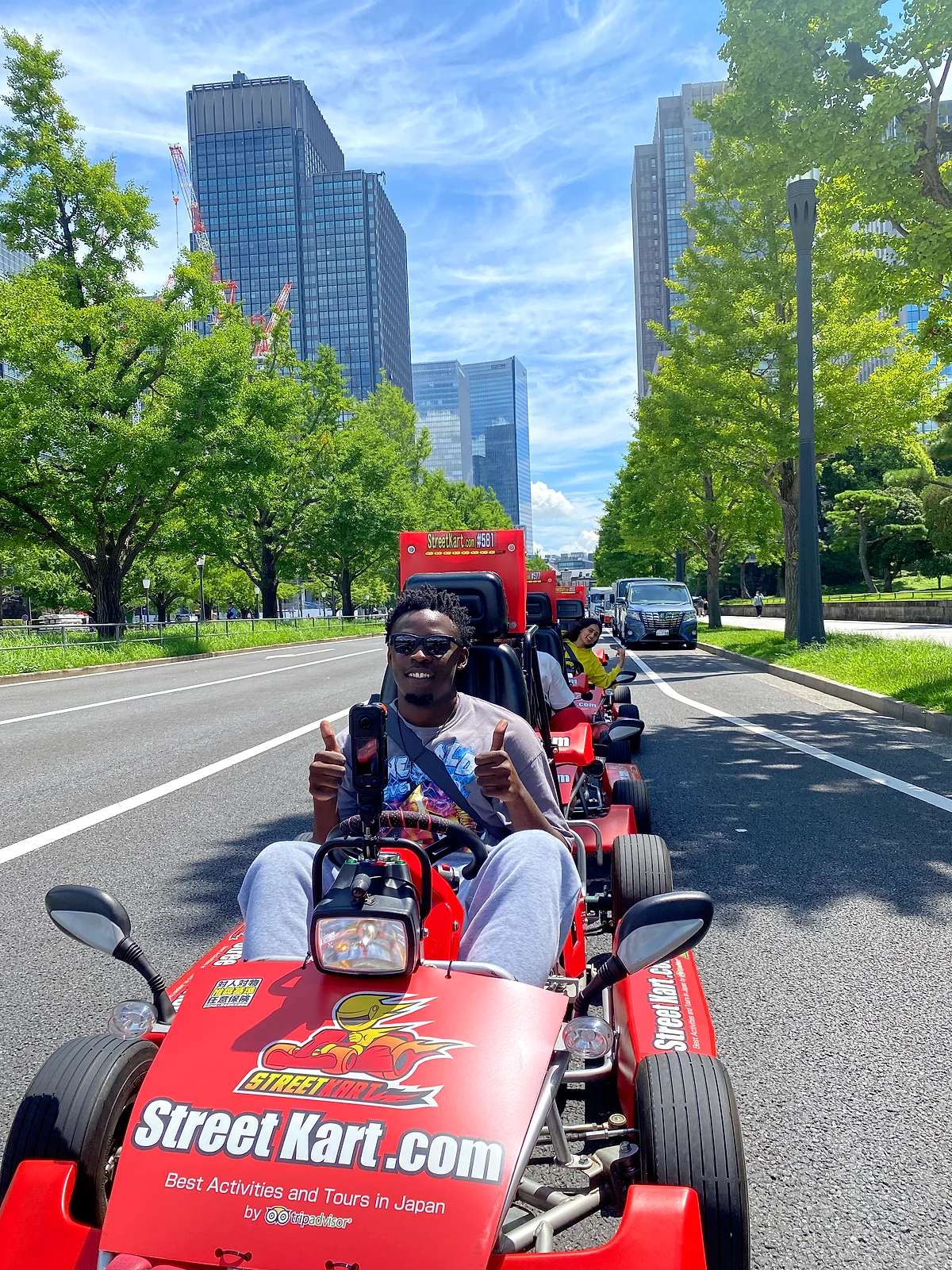
Street kart tours are led by a guide, and that's exactly why the second ride is so much fun. (For details on the actual routes, check the official website at kart.st.) Since you're not preoccupied with the route, you see more. The color of the sky reflected in office windows. The clothes of people passing on the sidewalk. The sounds layering over each other at intersections. Things you went right past the first time keep catching your eye.
That's why the one thing we really want you to change on your second ride is the time of day.
November in Tokyo is the season when the days get noticeably shorter. If you rode in summer, you'll be surprised how different the sky looks at the same hour. So this article won't tell you "go at such-and-such o'clock," because the view changes so much with the seasons. Instead, think about just one thing: if your first ride was in the bright middle of the day, could you pick an earlier slot this time, or one as the sun starts to go down? Check the available time slots on the official website (kart.st).
If you're changing the time of day, rethink what you'll wear too. You're in the wind the whole ride, so an early slot and a late-afternoon slot can feel completely different in terms of chill. Always bring a jacket suited to the season. Closed-toe sneakers are recommended. Avoid open-toe shoes, heels, skirts and dresses. If you thought "that was colder than I expected" or "I sweated more than I thought" on your first ride, that memory is your best guide.
Think of the weather as part of the scenery, too. In light to moderate rain, tours go ahead as scheduled and raincoats are provided free of charge. A city where building lights blur across wet asphalt shows a completely different face from a sunny day. In heavy rain or typhoons, however, tours are canceled. If that happens, you can choose between a shortened tour (with the difference refunded), rescheduling, or a full refund. Longer courses may also be shortened depending on the weather, so be prepared for that on days when the sky looks iffy.
The morning face and evening face of each store's area
There are seven stores in Tokyo. However, Akihabara Store 1 and Store 2 are in almost the same place, as are the Shibuya store and Shibuya Annex. If you're dividing them by scenery, it's easiest to think in four areas: the bayside Tokyo Bay store (Shinkiba) and Shinagawa store, plus Akihabara and Shibuya.
The two bayside stores (Tokyo Bay and Shinagawa): the color of the sea, the color of the bridge
On the Tokyo Bay store's route, two landmarks take the starring roles: the 798-meter Rainbow Bridge and the 333-meter Tokyo Tower. Add to that the futuristic cityscape around Odaiba.
In an early slot, the bayside roads of Shinkiba still hold the crisp morning air. A breeze with a hint of salt brushes your cheeks. The shadows of the big warehouse buildings stretch long across the road, and the sea surface glints a pale white.
As the sun goes down, though, the very color of the air changes. Against a sky sinking from orange to deep blue, the red-and-white silhouette of Tokyo Tower stands out sharply. If the season and your departure time line up just right, you might even catch the bridge as its seven-color illumination comes on. ...Putting it mildly, that's seriously moving!
Tokyo Tower was completed in 1958. The steel tower that has symbolized Showa-era Tokyo and Odaiba's futuristic buildings line up side by side in the same field of view. In the morning, the open feel of the bay gives you a sense of "the day ahead." In the evening, two landscapes from different eras melt into a single night view. The Tokyo Bay store's course is described as offering night views on evening slots. If your first ride was a daytime one, this is the combination we'd recommend first.
What you do before and after the tour also changes your impression of the day. With a morning slot, have a sushi or seafood-bowl breakfast at Toyosu Market before heading to the store. With an evening slot, flip it: explore Odaiba first, then go take in the Rainbow Bridge night view after your ride. Same course, but just by swapping how you spend the time around it, you get a whole "morning on the bay" day or a whole "night on the bay" day.
On the Shinagawa store's route, the highlights include the Rainbow Bridge seen from the Shinagawa side, Tokyo Tower in the distance, and the Takanawa and Shibaura, Tamachi areas. Shibaura, Tamachi is a bayside business district. In the morning, it shows its "working Tokyo" face, with people in suits being swallowed up by office buildings. In the evening, office windows light up one by one, with Tokyo Tower standing beyond them, and suddenly the sense of distance turns dramatic. The more you remember the blue bay from your first ride, the more we want you to see the "bay of lights" the second time.
The Takanawa area is a neighborhood of history and temples, home to Sengakuji, where the graves of the 47 Ronin of Ako are located. Step just a little away from the high-rises around Shinagawa Station and the atmosphere suddenly calms. Noticing that contrast is something only a second-timer who knows the route can do.
If you want to stop somewhere before or after the tour, Shinagawa Shrine, within walking distance of the store, is a good option in the morning. The grounds have a Fujizuka (a miniature Mt. Fuji mound), and taking a slow walk in the clear morning air before you ride makes the bayside scenery afterward stand out even more. With an afternoon slot, head to canal-side Tennozu Isle after your ride. The area is full of art galleries and cafés, perfect for gazing at the water and reliving the views you just saw.
The two Akihabara stores: a red-brick station and the streets of Ginza
The Akihabara stores' route features a luxurious trio: the Marunouchi Building of Tokyo Station, which opened in 1914 and completed its restoration in 2012; Ginza, home to the Wako clock tower; and Akihabara's Electric Town. This combination honestly looks totally different depending on the time of day.
Early on, Akihabara's signs are still fairly subdued, and the city has a quietness as if it's taking a deep breath. Ginza, too, looks more like "a town before work" than a shopping district. When soft light hits the red-brick station building, the texture of the bricks stands out clearly.
In the evening, it's the opposite. Electric Town's signs all wake up at once, and shop-window lights start illuminating Ginza's sidewalks. If you thought "so this is what Akiba is like" on your first ride, try riding again at a different time. You'll definitely be going, "Wait, this is the same town!?"
Ginza has been a busy commercial district since the Meiji era. On your first ride, you may have passed the Wako clock tower at the 4-chome intersection thinking little more than "there was some impressive building there." This time, when you stroll around Ginza before or after the tour, drop by with the idea of checking what time the clock hands are pointing to. The clock tower in the morning, the clock tower in the evening. That alone leaves you with your own personal "time-of-day comparison" as a single memory.
If you choose a morning slot, we also recommend visiting Kanda Myojin before you set off. It's a shrine with 1,300 years of history, once the guardian shrine of all Edo, and early in the day its grounds have a calm completely unlike the bustle of Electric Town. Then head back to the store, breathe in the still-quiet Akiba air, and start your ride. With an evening slot, go see Tokyo Station's red-brick building or have dinner in Ginza after your ride. You can retrace on foot the scenery you saw from the kart.
Shibuya store and Shibuya Annex: the crossing and the tree-lined avenue
The scenery featured on the Shibuya route includes the Shibuya Scramble Crossing, the zelkova-lined avenue of Omotesando, and the area around Harajuku's Takeshita Street.
Early in the day, Shibuya's star is the flow of commuters. Everyone is in a hurry, yet somehow they move in an orderly way. On Omotesando, light filters through the leaves of the zelkova trees, and the high-end brand buildings are still quiet.
Once the sun starts to set, everything changes. The lights around the crossing grow brighter, and the flow of people becomes livelier and more scattered. It's the same crossing, but even the kinds of sounds you hear change.
The zelkova trees of Omotesando are a well-known photo spot, famous for their winter illuminations too. The avenue is lined with distinctive buildings designed by architects, so as the light changes, even the shapes of the buildings look different. Takeshita Street's colorful storefronts also shift: early on, it's the color of the shutters; in the evening, the colors of people and signs. Harajuku is a town where the lead color keeps changing.
If you're aiming for an evening slot, try this order: before departure, watch the sunset from Shibuya Sky, the observation deck at Shibuya Scramble Square. Look down on the crossing from the top of the 230-meter building, then ride through it at street level afterward. Comparing the same city from above and below is a small luxury. With a morning slot, extending your day to Meiji Jingu after your ride to cool down in the forest in the middle of the city is nice, too.
But this part is important, so let's pause here. While riding, focus on your guide and the vehicle in front of you. It's best to just "remember the differences in scenery with your eyes and ears." We recommend taking photos around the store before and after your ride.
If you plan to take photos with your smartphone or camera, bringing a portable battery will give you peace of mind. With an evening slot, your battery drains fast as you snap away before and after the tour. Pack your belongings in a small bag that fits on the kart. The store lockers are for small items and aren't suitable for large luggage like suitcases.
Tips for spending the day comfortably with companions of different ages and fitness levels
If you're going with companions, let them know in advance that the karts are single-seaters and you can't carry a passenger. Eligibility requirements depend on each person's circumstances, so check the official website (kart.st) before you go. The karts have no suspension, and riding is not recommended for pregnant people. Tell any companions who won't be driving that the tour starts and ends at the store, and decide on one meeting spot near the store.
Deciding in advance how the waiting side will spend their time makes the day much easier. There's a convenience store within a five-minute walk of every store, and each store has restrooms. In Akihabara, they could browse Electric Town and anime shops; in Shibuya, grab a crepe on Takeshita Street. Give the people waiting their own little treat, and when you meet up after your ride, the "So how was it?" conversation will be lively on both sides.
Three things to decide before booking your second ride
There are just three things to decide.
Which area's store to choose. Whether you can pick a different time slot from your first ride. And what you want to compare at that time of day. On the bay, it might be the pale glinting sea in the morning versus Tokyo Tower's silhouette against the evening sky. In Akihabara, the quiet morning Electric Town versus the evening when the signs wake up. In Shibuya, the morning when commuters take center stage versus dusk when the lights grow brighter. Pick a combination that's likely to show you a different face from the one you saw the first time. Check the available time slots on the official website (kart.st).
Here's one more small tip. Before booking, look back at your photos from the first ride and pick just one place that left an impression. On your second ride, see that place in a different time of day's light. When you know exactly what you're comparing, you'll have far more "oh, this looks different from last time" moments, even while riding.
Once those three things are decided, double-check what to bring on the day. Drivers must bring the original of their driver's license. If you don't have everything required on the day, you won't be able to participate and won't be refunded. Even if you rode without any issues the first time, it's a good idea to double-check your license type and expiration date on the driver's license page.
Once these three things are settled, your second street kart ride isn't just "one more time." It becomes an experience of "going to meet another Tokyo."
As of November 2023, across all stores combined, there had been more than 150,000 tours, over 1.34 million customers, and more than 20,000 reviews, with an average rating of 4.9 out of 5.0. The website is available in 22 languages. However, guidance on the day of the tour is basically in English. Support in other languages depends on the staff on duty, so if you're concerned, contact them in advance through the official website. Cancellations up to seven days before are free. Check the official website for detailed conditions.
Weekends tend to book up quickly, so we recommend reserving early. For how to book and the latest information, check the official website.
Will you watch the buildings wake up one by one in the morning city? Or watch the lights come on one by one in the evening city? Either choice is great. When you finish your ride, the "first-time Tokyo" in your memory will surely have been repainted in vivid new colors!
This article was originally written in Japanese and translated using AI. Some expressions may read unnaturally, and we appreciate your understanding. For the most accurate and up-to-date information, please refer to the official site at kart.st.
Street Kart is not affiliated with Nintendo or the Mario Kart series in any way. We do not provide costumes of Nintendo characters, and such costumes may not be worn during tours even if brought by participants.