
Riding a Street Kart Up and Down Tokyo's Hills: Where Will Your Companions Cry Out? The Views from Shibuya and Shinagawa
Riding a Street Kart Up and Down Tokyo's Hills: Where Will Your Companions Cry Out? The Views from Shibuya and Shinagawa
"If we were walking, we'd have had to stop for a break halfway up this hill, right?"
That's what you hear from the kart behind you. Just picture it for a moment.
On a map, Tokyo looks like one big flat city. In reality, it's full of hills! And when your group covers a wide range of ages and fitness levels, "Can everyone enjoy this without wearing out?" becomes a pretty big worry at the planning stage. We get it.
So this time, we're talking about what you see when you ride a street kart through Tokyo's hilliest areas. The real focus isn't the scenery itself, though. It's how your companions react. Who's likely to cry out, and where? And where might someone suddenly go quiet? Let's take it one spot at a time, focusing on two stores: Shibuya and Shinagawa!
Read the Characters "谷" and "高," and Tokyo's Hills Come into View
If you can read kanji, it might click the moment you open a map.
The "谷" in Shibuya (渋谷) means "valley," just as it does in Chinese. The "高" in Takanawa (高輪) means, quite literally, "high." Tokyo's place names are surprisingly honest about the terrain they sit on.
By the way, in Chinese a slope is "坡," and climbing one is "爬坡." In a hillside town like Jiufen in Taiwan, the only way to "爬坡" is on your own two feet. That endless run of stairs and slopes has its own charm. But if you're traveling with someone who has bad knees, it's honestly tough going. And that's exactly what makes riding a kart through Tokyo's hilly neighborhoods so much fun.
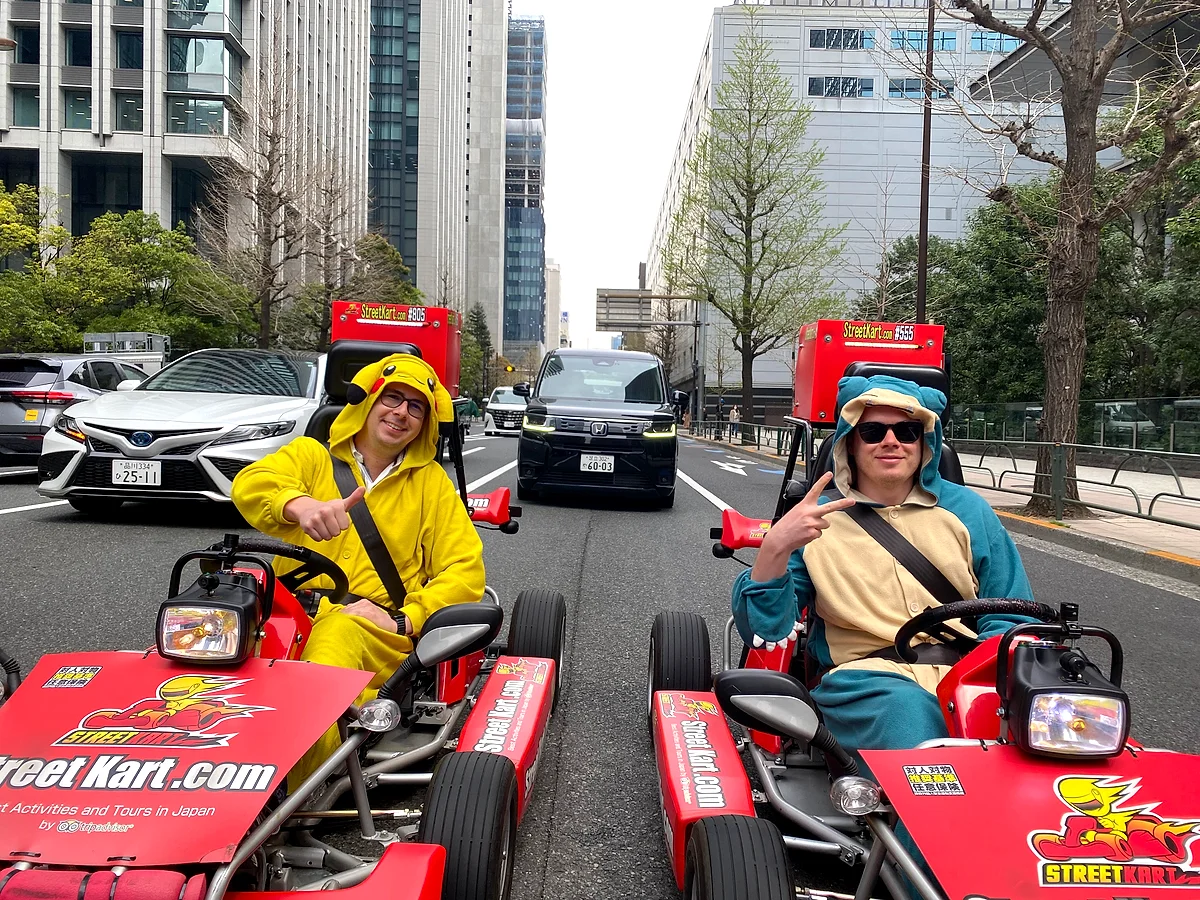
Street karts have no roof. You sit low, too, so your whole body feels even gentle inclines you'd never notice on foot. On an uphill, the back of the kart ahead seems to lift gently into the air. When you head downhill, the rows of buildings rush toward you! The scenery doesn't just slide past sideways; it moves up and down, too. Ride through a hilly area and you'll feel this clearly.
One more important thing: what gets you up the hill is the engine. Even on slopes that would leave you out of breath on foot, you barely use your legs. The people who usually say "Let's skip that hill" when sightseeing might be the ones whose eyes go wide here.
Shibuya Store: Head Down to the Bottom of the Valley, and the Scramble Crossing Opens Up
Shibuya's terrain is lowest around the station, with the surrounding neighborhoods rising up from there on slopes. A true "valley," just as the name says.
Street Kart's Shibuya store and Shibuya Annex are both in Maruyamacho, in almost the same spot. The nearest station is Shinsen Station, a 5-minute walk away, or it's a 10-minute walk from JR Shibuya Station.
The Shibuya store's tours pass through the Shibuya Scramble Crossing, Omotesando, and the Harajuku area. Meiji Jingu, Yoyogi Park, and NHK Hall are also near the route. From quiet streets at the top of the hill, the people and noise gradually build. That feeling of things getting more and more intense shows up directly in your companions' reactions.
Take someone who's seen footage of Shibuya in international news or movies. As you approach the Scramble Crossing and find yourself surrounded by buildings, I bet they'll call out, "Oh, I've seen this place!" On foot, you get swallowed up in the crowds at this crossing, but from a kart's low vantage point, it becomes a view you look up at. Skyscrapers like the 230-meter Shibuya Scramble Square tower overhead, and it's overwhelming, to say the least.
One of the Shibuya store's tours, Tour H2S, runs from the Shibuya Scramble Crossing toward Omotesando and Harajuku. The driver may be too busy looking ahead to take in much else. Once you reach the finish, ask the friends who were riding behind you what the view was like.
On the other hand, some people don't like crowded places. Those folks will probably look relieved once you've left the bustle around the station behind. Meiji Jingu, near the route, is a shrine surrounded by a forest of about 700,000 square meters, and Yoyogi Park is a vast green space in the heart of the city. Stop by before or after your tour and you'll meet a completely different Shibuya from the heat of the canyons between the buildings. Every time you go up or down a hill, the city's expression flips. That's what makes this neighborhood so interesting.
The Person Who Suddenly Goes Quiet Under Omotesando's Zelkova Trees
Let me pause here for a moment.
Someone who's been excited the whole time goes quiet the moment you turn onto Omotesando. That's a very easy scene to imagine.
Omotesando is a grand avenue lined with zelkova trees. Distinctive buildings designed by architects, such as Omotesando Hills and Tokyu Plaza Omotesando Harajuku, line the street. After soaking in the overwhelming scenery in front of Shibuya Station, the sight of tree trunks lined up at even intervals settles your eyes and your mind. Branches arch overhead and the light turns soft. The mouth that kept saying "Wow!" a minute ago quietly closes. That profile in that moment is something worth seeing.
The zelkova-lined avenue is also known as a photo spot for its Christmas illuminations. That said, how it looks varies a lot with the season and weather, so check on-site to see what you can catch and when.
Then, when you enter the Harajuku area, the atmosphere changes completely again! The bright colors around Takeshita Street jump out at you, and this is where your fashion-loving friends will likely get a huge burst of excitement. Lively Shibuya, calm Omotesando, colorful Harajuku. Because the mood keeps shifting, the person calling out changes each time, too.
Shinagawa Store: Takanawa's Streetscapes and Bayside Views
The Shinagawa store is in Kita-Shinagawa. It's a 3-minute walk from Kita-Shinagawa Station on the Keikyu Main Line, or a 10-minute walk from JR Shinagawa Station.
Landmarks on the Shinagawa store's routes include the area around Shinagawa Station, the Takanawa area, the Shibaura/Tamachi area, plus Rainbow Bridge and Tokyo Tower. Takanawa, true to the "high" in its name, sits on elevated ground. Its streets are dotted with historic temples and embassies. Sengakuji, home to the graves of the 47 Ronin of Ako, is also in this area. It's known as the sacred site of the Chushingura story, so friends who love period dramas or historical novels might lean in just hearing the name.
Time flows at a different pace here than in Shibuya. Instead of waves of people, you'll find walls, groves of trees, and quiet buildings. Since the engine does the climbing, older companions who usually say "Let's skip that hill" will end up gazing at walls and trees from a low seat. If someone murmurs, "So there's a Tokyo like this, too," it'll probably be around here. It's a quieter face of Tokyo, a little different from the one on guidebook covers.
The Shibaura/Tamachi area is a business district with office buildings and bayside scenery. Viewed from the Shinagawa side, Rainbow Bridge is a landmark of the waterfront. It's a 798-meter suspension bridge lit up in seven colors at night.
And one more thing: Tokyo Tower in the distance. The red-and-white steel tower stands 333 meters tall and was completed in 1958. The moment it peeks out between buildings, someone is bound to point and ask, "Is that Tokyo Tower?"
The Shinagawa store's S-S course runs from Shinagawa Station toward Tokyo Tower. At first, the tower peeks out small between the buildings, then gradually grows bigger as you go. The person who pointed and asked "Is that Tokyo Tower?" falls quieter the closer you get, until in the end they're just looking up at it. That kind of shift could easily happen. Instead of looking down on the city from an observation deck, you look up at a symbol of the Showa era from a low seat. It's a view unique to the Shinagawa route.
If You Prefer Flat Scenery, Consider the Tokyo Bay Store
Some companions might say, "I'd rather take it easy and enjoy flat waterfront views than hills." In that case, consider the Tokyo Bay store in Shinkiba, too. Its routes include Rainbow Bridge and Tokyo Tower, as well as the Odaiba area, and mostly follow open roads along Tokyo Bay. The hill-lovers versus the sea-gazers: choosing a store based on which group is bigger is totally fine!
Four Things to Talk About Before Going with a Group of Mixed Ages and Fitness Levels
Once you have a picture of the scenery, it's time for the practical preparations. To make sure everyone has a comfortable time, here are four things worth discussing before you set out.
First: who's driving? The karts are single-seaters, so no passengers are allowed. Everyone who joins the tour drives their own kart. Participants must be 18 or older and carry an original, valid driver's license that permits them to drive a four-wheeled motor vehicle. Digital licenses are not accepted. The required documents vary depending on the issuing country and the type of license, so be sure to check the Street Kart official website before booking. If you don't have the right documents on the day, you can't take part, so this really matters!
Second: what will non-drivers do during the tour? If some of your group won't be joining, it helps to decide on a place for them to wait near the store. From the Shibuya store, Hachiko Statue, the Shibuya Scramble Crossing, and Shibuya Hikarie are all within a 10-minute walk. From the Shinagawa store, Shinagawa Shrine is a 5-minute walk. Shinagawa Shrine has stone steps and a Fujizuka (a miniature Mount Fuji mound), so anyone unsure about their legs might prefer to look around from the bottom. Tennozu Isle, along the canals, is a 20-minute walk from the Shinagawa store and is home to cafés and art galleries. It's a good pick for people who enjoy a leisurely stroll.
Third: language. On the day of the tour, guidance is generally in English. Whether you can get guidance in Japanese or other languages depends on the staff that day and isn't guaranteed. If anyone in your group is uneasy about English, it's a good idea to send any questions through the official website in advance. The website is available in 22 languages.
Fourth: getting there and when to book. The stores don't have parking, so use public transportation. Weekends tend to fill up, so we recommend booking early once your dates are set. Reservations are accepted via Facebook, LINE, and email; check the official website for the contact points. Prices vary by season and time of day, so check the latest prices on the official website (kart.st) as well.
Also, make sure everyone knows about clothing and weather. Drivers should wear closed-toe shoes like sneakers and clothes that are easy to move in. Avoid open-toe footwear such as sandals, heels, skirts, and dresses. If anyone plans to dress up and stroll Omotesando or Shibuya after the tour, it's a good idea for them to plan separate shoes for driving. As for weather, tours go ahead as scheduled in light to moderate rain, with free raincoats provided. They're canceled in heavy rain or typhoons. For details such as your options in that case, check the official website.
Just one more thing. While driving, following Japanese traffic rules and your guide's instructions is an absolute must. Take photos and videos before you set off or after you return. And when you meet up with the friends who were waiting, start by asking, "What was your favorite part?" I bet everyone will name a different place. Add those answers straight to your photos, and you'll have a shot that looks back on the hillside views in everyone's own words.
What Makes Street Kart Great
Now let's look at what makes Street Kart a reliable choice for touring a hilly city.
First, on every tour, a trained guide rides at the front and leads the way along each store's route. No one has to squint at a map and figure out directions; you just follow the guide ahead of you. Since everyone sees the same scenery in the same order, when you're swapping impressions afterward, "That spot!" "Yes, that spot!" actually lands.
Next, the number of stores. Street Kart has 9 stores nationwide: 7 in Tokyo, 1 in Osaka, and 1 in Okinawa. Of the 7 Tokyo stores, Akihabara Store 1 and Store 2, and the Shibuya store and Shibuya Annex, are each in nearly the same location. If you want to see Tokyo Station's red-brick building or the streets of Ginza, the routes from the Akihabara stores are worth considering.
Third, its track record. As of November 2023, across all stores, it had run more than 150,000 tours in total and served more than 1.34 million customers. It had more than 20,000 reviews, with an average rating of 4.9 out of 5.0. These figures are from a while back, so check the official website for the latest information.
Go Find Out Who Cries Out First at the Top of the Hill
In Shibuya, waves of people and canyons of buildings. In Takanawa, quiet streets of temples and shrines. Beyond Shibaura, Tokyo Bay and Rainbow Bridge. Even within the same "hilly Tokyo," change the area you ride through and both the person who cries out and what they say will change.
What you need to decide in advance: who's driving, where the people waiting will spend their time, and how you'll handle language and booking. Talk those through, and even a group with different fitness levels should be able to enjoy Tokyo's ups and downs each in their own way.
Now, think back to that voice at the very beginning: "If we were walking, we'd have had to stop for a break halfway up this hill, right?" The one saying it is someone right next to you. And the next one to point and ask, "Is that Tokyo Tower?" will probably be someone else.
Let's go find out for ourselves!
You can check participation requirements and the latest information on the Street Kart official website. If you're going on a weekend, we recommend getting started the same day your dates are set.
This article was originally written in Japanese and translated using AI. Some expressions may read unnaturally, and we appreciate your understanding. For the most accurate and up-to-date information, please refer to the official site at kart.st.
Street Kart is not affiliated with Nintendo or the Mario Kart series in any way. We do not provide costumes of Nintendo characters, and such costumes may not be worn during tours even if brought by participants.