
How the Scenery Changes at Each Tokyo Street Kart Location: Enjoying the Ride Together When You Differ in Age and Stamina
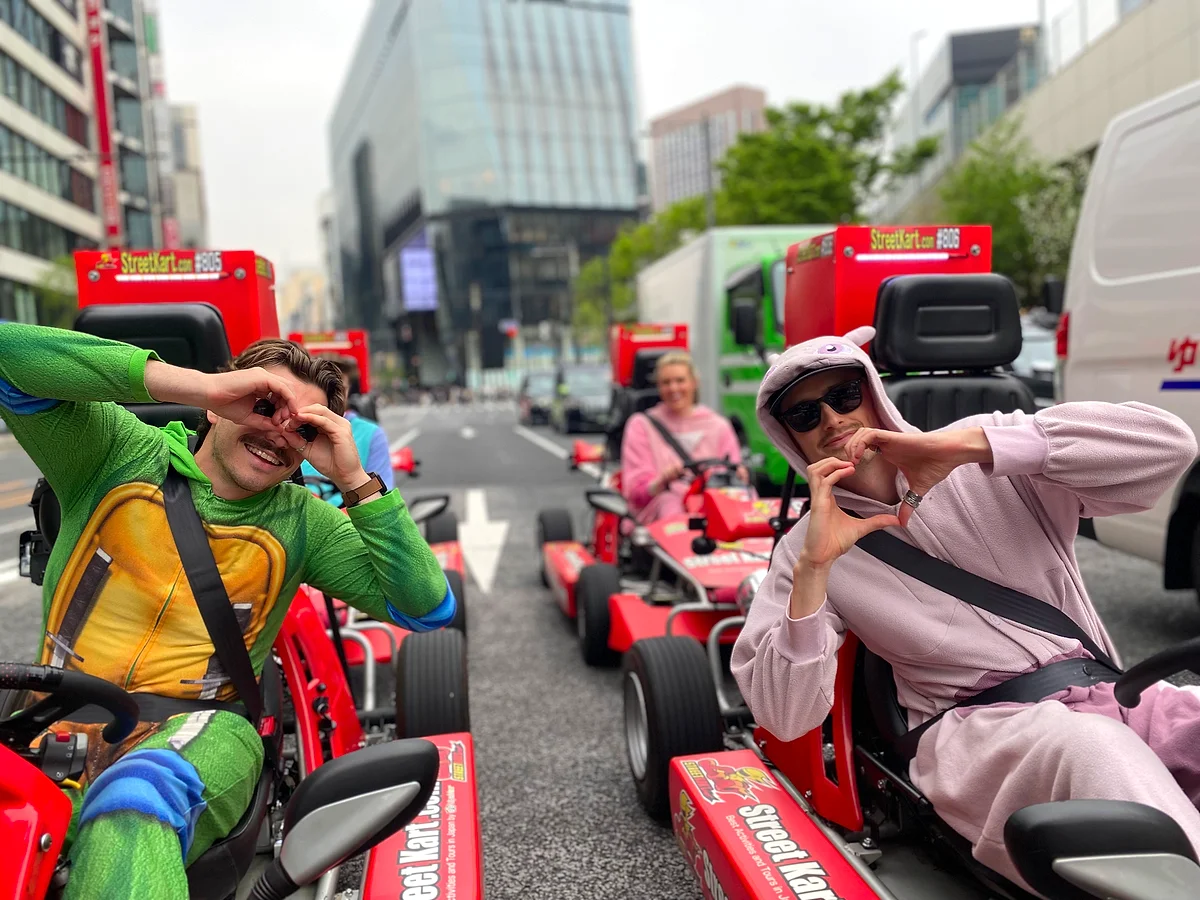
How the Scenery Changes at Each Tokyo Street Kart Location: Enjoying the Ride Together When You Differ in Age and Stamina
The light turns green. The guide at the front raises a hand, and the line of karts slowly starts to roll. The buildings you were just looking up at slide away behind you, and as you turn a corner, the sky suddenly opens up.
That's the moment!
A Tokyo street kart tour is time spent side by side, taking in the moments when the scenery shifts. But the person next to you may be a different age or have a different level of stamina. A parent and their grown-up son or daughter. Siblings with a big age gap. Friends who go way back. In this article, we'll look at how the scenery changes at each location, along with ways to spend the day for both the person who drives and the person who doesn't. Read it as if you're sitting right next to us.
Three Things to Decide Together Before You Set Off
The first thing to decide is who's going to drive. In Taiwan, riding on the back of someone's scooter is an everyday sight, but with street karts it's one person per kart. You can't ride as a passenger. If you're both going, that means two karts and two drivers.
Each of you enjoys the same city from your own kart. Picture it for a moment: the same intersection, the same bridge, the same tree-lined avenue, with each of you seeing it from your own seat. Honestly, that feeling of seeing the same thing together is pretty moving.
That said, you may not both be able to drive. To take part, you need a driver's license and have to meet other requirements. If you're coming from overseas, you'll need to check in advance whether your license is valid. For details, see the official driver's license page. We won't try to give a definitive answer on age or other requirements here. Check the official website for both of you before you go, so you're not scrambling when you get to the store on the day.
The second thing is language. On the day of the tour, guidance is given mainly in English. Whether guidance is available in Japanese or other languages depends on the staff that day and isn't guaranteed. If either of you isn't confident in English, it's a good idea to ask through the official website beforehand. By the way, the website is available in 22 languages, including Traditional Chinese. When you read the requirements and important notes, pick whichever of the 22 languages is easiest for you.
The third thing is the date. Weekends tend to book up quickly, so if you want to ride on a Saturday or Sunday, book early. If your schedule allows, consider weekdays as well, which gives you more options.
Now, let me suggest one way to match your pace with each other. "Both of us ride" isn't the only right answer! The person who drives joins the tour. The other enjoys the sights near the store. When the ride is over, you meet back up and compare notes: "So where did you go?" Splitting things up this way lets someone who's less confident about their stamina spend the day at their own pace. I'll go into plenty of detail on what's around each store in the next section.
The Way the Scenery Changes Is Completely Different at Each Location
Street Kart runs guided tours, and each location has its own set route. You can't just drive anywhere you like. But look at it the other way around: the location you choose determines how the scenery will change along the way.
There are seven locations in Tokyo. However, Akihabara Store 1 and Store 2 are in almost the same place, as are the Shibuya store and Shibuya Annex. If you're choosing based on scenery, it's easiest to think in terms of four areas: the Bay Area, Akihabara, Shibuya, and Shinagawa.
Once you're in a kart, the height of the buildings, the breeze off the water, and the sounds of the city all feel much closer. That's all I'll say about the karts themselves. From here on, let's look at how the scenery changes from one thing to the next at each location.
Tokyo Bay Store (Shinkiba): From Warehouses to the Bay, Then the Rainbow Bridge
Shinkiba, home to the Tokyo Bay store, is a waterfront district along Tokyo Bay. The sea, warehouse districts, modern buildings. Straight-edged architecture and wide-open roads, with a whiff of salt air from Tokyo Bay mixed in.
Highlights include the Odaiba waterfront subcenter, an area lined with futuristic buildings such as the Fuji TV headquarters. For the order of the sights and route details, please check the official website (kart.st).
And then there's the Rainbow Bridge! This 798-meter suspension bridge spans Tokyo Bay and is lit up in seven colors at night. In the distance stands the red-and-white, 333-meter Tokyo Tower. Completed in 1958, this symbol of the Showa era rises beyond the new waterfront skyline. Old Tokyo and new Tokyo overlap in a single view.
In Chinese, the scenery you pass along the way is called "沿途風景" (yántú fēngjǐng), and this route is all about exactly that. Warehouses, futuristic streets, the sea, the bridge, the tower. The views change one after another, so when you finish, try asking each other, "What was your favorite part?" You might give different answers. Talking about those differences is part of the fun.
For a companion who isn't driving, one option is a café break at CASICA near Shinkiba Station (an 8-minute walk from the store). If you want to go a bit further, Kasai Rinkai Park is about 15 minutes away by car, with a giant Ferris wheel and Tokyo Sea Life Park. Note that the store has no parking, so please use public transportation to get there and back.
The Two Akihabara Stores: From Electric Town Signs to Red Brick, Then the Ginza Clock Tower
On the Akihabara route, watch how the colors of the scenery change. You start in Electric Town, lined with Yodobashi Camera and Akihabara UDX. Anime and subculture signs crowd every surface, and the sheer amount of color hitting your eyes is something else!
Depending on the course, you then head toward the Marunouchi building of Tokyo Station. This red-brick station building opened in 1914, finished its restoration in 2012, and is designated an Important Cultural Property. From primary-colored neon to the calm red of brick. Then, entering Ginza, you add the dignity of a shopping district dating back to the Meiji era: the Wako clock tower, the Kabukiza theater, Ginza Mitsukoshi, and Matsuya Ginza. You set off from a subculture hub and arrive in a grown-up part of town. That progression is really fascinating.
Nearby you'll also find Kanda Myojin, the guardian shrine of old Edo with 1,300 years of history, and the student district of Ochanomizu, home to Nikolai-do Cathedral. My friends in Taiwan often ask, "Akihabara is the otaku district, right?" But drive a little and you'll come across red brick and a clock tower. I'd love for you to see that range with your own eyes.
Before or after the tour, a visit to Kanda Myojin, a 10-minute walk from the store, is a relaxing way to spend time. About 5 minutes away by train is Ueno Park, with Ueno Zoo, the Tokyo National Museum, and the National Museum of Western Art. It's easy to plan a day where the non-driving companion takes their time at a museum and meets up later with the one who drove.
I also recommend taking the train 10 minutes to Ginza and walking to see the clock tower you passed in the kart. Seeing the same view twice at different speeds changes your impression of it more than you'd expect.
The Two Shibuya Stores: From the Crowds at the Crossing to the Green of the Zelkova Trees
The theme of the Shibuya route is the shift from crowds to greenery. You start at the Shibuya Scramble Crossing, where as many as 3,000 people cross at once. Hachiko Square, SHIBUYA109, and the redevelopment-era Shibuya Hikarie and Shibuya Scramble Square are right there in view.
From there, you head to Harajuku's Takeshita Street. Colorful storefronts and the sweet smell of crepes.
Then, the moment you enter Omotesando, the atmosphere changes. Green zelkova trees and distinctive buildings designed by architects. The buzz of the city quietly settles down. Nearby are Meiji Jingu, with its roughly 700,000 m² forest, and Yoyogi Park. From crowded Shibuya to leafy Omotesando, you can clearly feel the change as you drive.
Omotesando also looks different with the seasons. The Christmas illuminations along the zelkova trees are a popular photo spot. Even on the same route, the avenue can feel completely different depending on when you visit.
For a non-driving companion, my top pick is Shibuya Sky, the observation deck at Shibuya Scramble Square (230 m), a 10-minute walk from the store. From up there, you can look down on the very streets your companion is driving through. Shibuya from above, and Shibuya at kart level. Put the photos side by side afterward. Even though it's the same city, they'll look like two different places. I highly recommend this two-photo set!
Meiji Jingu is a 20-minute walk from the store. If you're worried about your stamina, don't push yourself. Resting at a café around the Scramble Crossing, a 10-minute walk away, is a fine choice too. Shibuya Station is a 10-minute walk from the store, and Shinsen Station is a 5-minute walk.
Shinagawa Store: From the Business District to Historic Streets, Then the Waterfront
The Shinagawa route lets you feel the passage of time. You start around Shinagawa Station, where the Shinkansen stops. With high-rises like Shinagawa Intercity, it's Tokyo's southern gateway.
Highlights also include the Takanawa area, dotted with embassies and historic temples, including Sengakuji, home to the graves of the 47 Ronin of Ako. A city of skyscrapers and a slightly older Tokyo. Other highlights include the Shibaura and Tamachi business district overlooking Tokyo Bay, the Rainbow Bridge, and Tokyo Tower in the distance. The bridge seen from the Shinagawa side is a different angle from the Odaiba side. For the order of the sights and route details, please check the official website (kart.st).
Here are some options for before or after the tour, listed from closest to the store. Shinagawa Shrine, a 5-minute walk away, is one of Tokyo's Ten Shrines and has a torii gate carved with twin dragons and a Fujizuka (miniature Mt. Fuji mound). Note that there are stone steps, and the Fujizuka is meant to be climbed. If your companion isn't confident on their feet, simply looking up from below the torii is plenty. Honsenji Temple, a 10-minute walk away, has one of the Six Jizo of Edo and a large temple bell designated a Tangible Cultural Property of Tokyo. The nearest station to the store is Kitashinagawa Station on the Keikyu Main Line, a 3-minute walk. Near the station is the old-fashioned Kitashinagawa shopping street, perfect for a leisurely stroll.
If you still have time after your ride, head to Tennozu Isle, a 20-minute walk away. It's an area along the canals with art galleries and cafés. You can continue enjoying the waterfront scenery you saw on the tour, this time on foot.
Why People Choose Street Kart
Here's a summary of what sets the Street Kart service apart.
First, you're led by guides trained to work with foreign drivers. Even on roads in an unfamiliar country, you simply follow the guide driving ahead of you. Of course, you're expected to obey Japanese traffic rules and the guide's instructions.
Second, guidance on the day is mainly in English. If the two of you travel in English, that's a nice plus.
Third, the website is available in 22 languages. You can read the requirements and important notes, the kind of information you don't want to misunderstand, in whichever of the 22 languages is easiest for you before you go.
Fourth, each location has a clearly distinct character. The openness of the waterfront. The shift in color from Akihabara to Ginza. The greenery from Shibuya to Omotesando. The layers of history in Shinagawa. You can choose based on what you both like, and if you come to Tokyo often, you can pick a different location each time.
Fifth, there are plenty of things to do around each store before and after the tour. Even if you differ in stamina or tastes, you can plan the day by splitting it into driving time and rest time.
Sixth, its track record. As of November 2023, across all locations, they had run more than 150,000 tours, served more than 1.34 million customers, and received more than 20,000 reviews, with an average rating of 4.9 out of 5.0.
Turning the Changing Scenery into Shared Memories
One important request: while you're driving, focus on the road and don't touch your phone. Take photos in front of the store before you set off, and after the ride is over.
That's why I recommend going back on foot afterward to photograph places you passed on the tour. The Ginza clock tower. The zelkova trees of Omotesando. Go back and take a slow second look at the scenery you zipped past in the kart. The photos you take will surely get the two of you talking.
Whether you both rode or only one of you did, I think the best part of this experience is that time after you meet back up, asking each other, "Hey, did you see that?" You see the same scenery from different perspectives and bring different impressions back to share. Precisely because you differ in age and stamina, you'll have even more to talk about!
For booking, contact details, requirements, and what happens in bad weather, please check the official website. Weekends tend to book up quickly, so once the two of you have chosen your location and date, it's best to get in touch early.
So, which scenery will you start with? The light is about to turn green.
This article was originally written in Japanese and translated using AI. Some expressions may read unnaturally, and we appreciate your understanding. For the most accurate and up-to-date information, please refer to the official site at kart.st.
Street Kart is not affiliated with Nintendo or the Mario Kart series in any way. We do not provide costumes of Nintendo characters, and such costumes may not be worn during tours even if brought by participants.