
Plans Changed on the Day in Tokyo? No Need to Panic! Tips for Cutting Down Prep and Regrouping with Travel Companions of All Ages and Energy Levels
Plans Changed on the Day in Tokyo? No Need to Panic! Tips for Cutting Down Prep and Regrouping with Travel Companions of All Ages and Energy Levels
It's morning. You open the window of your Tokyo hotel room, and there's a light drizzle that wasn't in the forecast. You head down to the lobby, where one of the parents in your group gives a wry smile: "I walked too much yesterday. My knees are feeling it today." The plans everyone put together so carefully are already starting to wobble before you've even left.
...You know mornings like this, right? They happen on every trip!
But it's okay. There's no need to panic. The most exhausting part of a day when plans change isn't actually the change itself. It's "redoing all your preparations from scratch." So the answer is simple: reduce how much you have to redo. That alone makes regrouping on the day surprisingly easy.
In this article, we'll figure out together where to draw the line when exploring Tokyo with companions of different ages and energy levels: which preparations you can skip, and which you absolutely can't.
The most draining part of a same-day change is "redoing your preparations"
In Taiwan, even when plans change, there's that easygoing feeling of "we'll figure it out at a night market or a convenience store!" Japan is just as convenient. But Tokyo has one quirk: travel distances are long, and there are lots of train transfers.
So when one plan shifts, it never stops there. Your route changes. What you need to carry changes. So do your meeting point and your rest stops. The reshuffling cascades like dominoes, and before you know it, your energy has been drained. That's what really wears you down.
This is even more true for groups with a wide range of ages and fitness levels. If you rearrange things based on how the energetic members feel, the people who want to take it slow get left behind. Match everything to the most tired person, and the energetic ones end up bored. Whichever way you lean, someone has to put up with it.
So try shifting your thinking. Drop the assumption that "everyone has to go to the same places together." That alone makes regrouping remarkably easier.
The key is to build in plenty of "parts that don't need rearranging even if things fall apart" when you make your plans. I'll say it plainly: how flexible you can be on the day is mostly decided by how you prepare the day before! Let's look at exactly where to draw that line.
Clearly separate the preparations you can skip from the ones you can't
A trip that handles changes well isn't one with more preparation. It's one where preparation leans toward things you "only have to do once." Let's cut down on what you have to think about and make on-the-day decisions easier.
Pack one outfit and one set of gear that works all day
What happens if you try to switch outfits and bags for each activity? The moment plans change, you get the dreaded "we have to go back to the hotel first." In Tokyo, the round trip alone eats up a lot of time. What a waste!
So the trick is to narrow things down from the start to one set that works both indoors and outdoors.
Clothes you can layer to adjust to the temperature. A folding umbrella. Comfortable walking shoes. That's it. With just these, whether your plans switch to a café or to somewhere outdoors, you can keep moving without changing.
For bags, ideally one small bag per person. If you leave larger luggage at the hotel or in a coin locker, you'll stay light on your feet even if a change of plans means more moving around.
For companions who aren't confident about their stamina, it's reassuring to have them carry a drink and a small snack, so a day with lots of breaks won't be a problem. That said, Tokyo has convenience stores everywhere, so there's no need to carry everything with you. Accept that "if we run short, we can buy it along the way." That's a perfectly good way to cut down on preparation, too.
What you can't skip: "contacting" and "driving requirements"
Now for the opposite side. There's a line here you should never cut.
The first is contacting whoever you've booked with. Whether it's a restaurant or an activity, if you're changing your plans, contact them the moment you decide. That's the basic rule. Policies on changes and cancellations vary by provider, so don't act on guesses like "it'll probably be fine." Check the information you received when you booked, or the official information.
The second is the requirements for any plans that involve driving. The licenses required for driving are treated differently depending on the country and the type of document. You can't just improvise this on the day. What's impossible is impossible. If you're planning to drive, read the license information on the official website in advance. Please check the official website for details.
As long as you've taken care of these two things, you're free to rearrange everything else based on your mood and how you're feeling that day. It makes a world of difference to your peace of mind.
If your plans change on a day you've booked Street Kart
Some of you may have a street kart experience planned in Tokyo. If so, here's something you should know first.
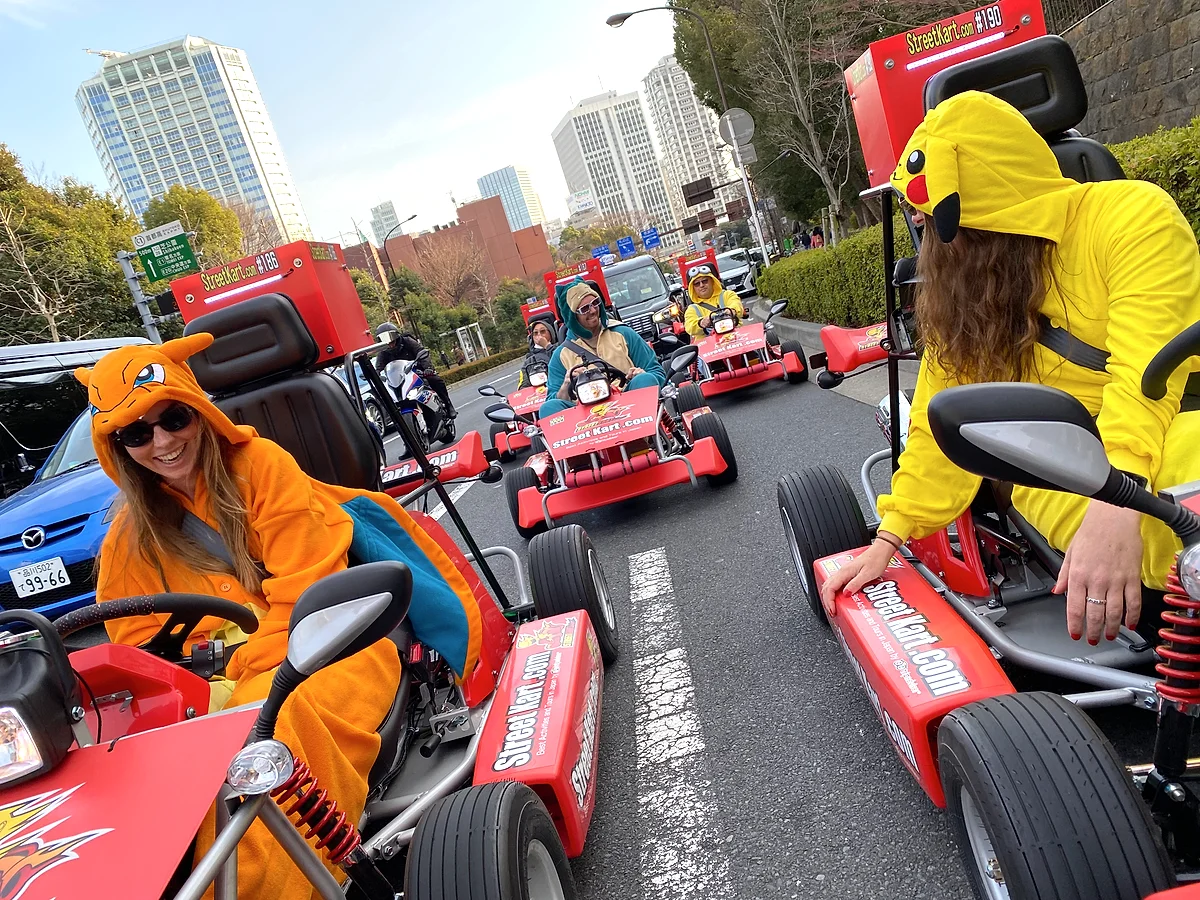
Street kart isn't about driving around wherever you like on your own. It's a tour led by a guide. You follow the guide driving in front of you, so there's no need to prepare by researching roads or planning a route yourself.
Instead, the thing to watch out for when plans change on the day is "can you get to the store on time?" That's the key. The stores don't have parking, so use public transportation such as trains. If a change of plans means you'll be heading there from somewhere else, double-check how to get to the store before you set out so you can move calmly.
What should you do about the tour if the weather turns bad or someone in your group isn't feeling well? The golden rule is not to decide on your own! Contact the same channel you booked through early and talk it over with them. Reservations are accepted via Facebook, LINE, and email, and the contact details are on the official website. For weather policies and conditions on the day of the tour, please check the official website for details.
One more thing: language. On the day of the tour, guidance is basically given in English. Guidance in Japanese or other languages depends on the staff working that day, so it can't be guaranteed. If anyone in your group is uneasy about English, ask through the official website in advance so you won't be flustered on the day. This is one preparation better not skipped.
Also, if your group size shrinks or grows, don't assume "it'll work out once we get there." The fastest way to find out how it's handled is to check with your booking provider. Here too: once you decide, contact them right away.
For companions who aren't driving, sweets at a Tokyo café are just right
The karts at Street Kart are single-seaters. No passengers are allowed. That's exactly why deciding in advance how non-drivers, or anyone who decides on the day that they'd rather sit this one out, will spend their time makes your plans much more resilient to change!
My recommendation is a plan where they wait at a Tokyo café near the departure store, enjoying some sweets. In Taiwan, waiting for friends at a bubble tea or shaved ice shop is the classic move, but my impression is that many Japanese cafés have a quiet atmosphere where it's easy to linger. For anyone who wants to sit down and rest for a while, it's perfect.
Parfaits made with seasonal fruit. Carefully baked cakes. Sweets at Tokyo cafés are beautiful to look at, and the waiting time becomes a travel memory in its own right.
The way to cut down on preparation here is not to lock in a single café. Save two or three options around the store's nearest station in your map app. That's all you need. If the first place is full, just walk to the next one. In lively neighborhoods like Shibuya or Akihabara, finding options shouldn't take long.
It's also a nice idea to have the people waiting at the café take photos for social media. Grab a window seat, shoot your sweets from directly above, and snap one while the light is still soft. On Xiaohongshu (RED), tags like "東京咖啡廳" and "東京甜點" work well, and on Instagram, try "#東京カフェ" and "#東京スイーツ." The Chinese word 甜點 (tiándiǎn) means sweets. If you post it alongside the Japanese word "スイーツ," your posts will more easily reach friends in both Taiwan and Japan.
Then, the drivers meet up with everyone at the café after the tour. While driving, focus on the road rather than filming, and save all the talk about photos and videos for when you regroup.
"So how was it!?" "We were eating this parfait!"
Everyone brings their own time to the table. That moment is the best part. You don't all have to do the same thing to enjoy the same day.
What makes Street Kart great
Looking at it from the angle of a trip that handles changes well, Street Kart has several features that cut down on the hassle of preparation. Note that Street Kart is an independent tour service with no affiliation whatsoever with any existing character franchises or their rights holders.
First, a trained guide leads the way. Even if you're not used to Tokyo's roads, you simply follow the guide in front of you. When driving in an unfamiliar city, many people will find that reassuring.
Second, you don't have to plan the route yourself. Even on a hectic day when plans have changed, once you arrive at the store, you can just go with the guide and the flow of the tour. It's a reliable ally on days when you want to cut down on preparation.
Third, the official website supports 22 languages. Take a moment to check the license requirements and tour precautions on a page in whichever language is easiest for you to read.
Fourth, the number of stores. There are 9 stores nationwide: 7 in Tokyo, plus one each in Osaka and Okinawa. However, in Tokyo, Akihabara Store 1 and Store 2, as well as the Shibuya Store and Shibuya Annex, are each in almost the same location. Start by confirming where your departure store is, then build the rest of your day's plans around it.
Fifth, its track record. As of November 2023, it has run over 150,000 tours in total, served over 1.34 million customers, earned an average customer rating of 4.9/5.0, and received over 20,000 reviews. For first-timers, that can be one useful factor in deciding whether to sign up.
And sixth. Let me pause here for a moment. It's the feeling of actually riding.
When you sit in the kart, your eye level drops dramatically. Suddenly, the buildings you always looked up at seem even taller and bigger. The wind on your face. The buzz of the city reaching your ears as you wait at a light. The footsteps of people crossing at the crosswalk right beside you. All of these are part of everyday Tokyo. And yet, just by shifting the angle you look up from a little, it feels as if you've wandered into a completely different city.
This is something you really have to experience with your own eyes and body.
On days when plans change, take care of that one contact before you move
Same-day changes to your plans are unavoidable, no matter how hard you try. That's exactly why the trick is to shape your preparations so that "nothing needs to be rearranged even if things fall apart."
Clothes and bags: one set that works all day. Cafés: don't lock one in, just save two or three options on your map. And decide in advance where the non-drivers will spend their time. With just this, you'll be able to move much more calmly on a rainy morning or a morning when someone isn't feeling well.
On the other hand, contacting your booking provider and checking the requirements related to driving are the two things you must never skip. If you have street kart in your plans, take a look at the official website before you leave for the license requirements and information about the day. If you change your plans, contact them right away through whichever channel you used to book, Facebook, LINE, or email, as soon as you decide.
On a trip with companions of all ages and energy levels, it's only natural that not everyone can move at the same pace. And that's perfectly fine!
Some take the wheel and feel the Tokyo breeze. Some catch their breath over café sweets. And in the evening, everyone gathers around the same table again, eagerly swapping stories: "Listen to what happened today!" If you plan things this way, one plan falling through won't bring down the whole day.
So, before your next trip to Tokyo, why not start by picking two cafés to save?
This article was originally written in Japanese and translated using AI. Some expressions may read unnaturally, and we appreciate your understanding. For the most accurate and up-to-date information, please refer to the official site at kart.st.
Street Kart is not affiliated with Nintendo or the Mario Kart series in any way. We do not provide costumes of Nintendo characters, and such costumes may not be worn during tours even if brought by participants.