
Regional Dialects & Culture in Tokyo – go-kart.tokyo
To enhance your street kart experience in Tokyo, it’s helpful to familiarize yourself with local dialects and cultural customs. While Tokyo is a diverse metropolis where various cultures converge, understanding regional expressions and traditions will deepen your appreciation of the city.
Common Dialectal Expressions
Tokyo’s dialect, known as “Edo-ben,” has evolved to closely resemble standard Japanese in modern times. However, you’ll still encounter distinctive expressions when conversing with locals.
Sentence endings like “~dabe” and “~jan,” along with personal pronoun variations such as “atashya” and “omee,” are still used in Tokyo’s downtown districts. Traditional Edo-ben words like “hyakkoi” (cold) and “beraboume” (absurd) also persist in everyday conversation.
While exploring Tokyo on your street kart, you may encounter these dialects when interacting with residents. Areas like Asakusa and the shitamachi (downtown) districts have particularly preserved traditional speech patterns.
Contemporary Tokyo Expressions
In business districts and youth-oriented neighborhoods, you’ll hear different linguistic patterns. Casual expressions like “maji de” (really/seriously), “yabai” (awesome, used positively), and “~ssu” (casual form of “desu”) are commonly used in daily conversation.
During your street kart tour, you’ll likely hear these expressions from guides and staff. Appreciating these dialectal variations is part of experiencing Tokyo’s rich linguistic culture.
Local Customs and Etiquette
Tokyo has unique cultural practices. On escalators, people typically stand on the left side, leaving the right side open for those in a hurry (this is reversed in Osaka). In trains, maintaining quiet is considered proper etiquette, and phone conversations are generally avoided.
In restaurants, there’s no need to respond to the greeting “irasshaimase” (welcome). Tipping is not customary, as service charges are included in the standard price. This applies to street kart experiences as well.
Tokyoites are punctual and value timeliness. We recommend arriving with ample time before your street kart reservation.
Street Etiquette
When walking through Tokyo or driving your street kart, several unspoken rules apply. Pedestrians generally keep to the left, though following the flow during crowded times is more important.
Smoking is permitted only in designated areas, with street smoking prohibited by ordinance in many wards. Waste should be taken home or disposed of in designated bins. Maintaining clean public spaces is an integral part of Tokyo culture.
Photography is generally unrestricted, but respecting others’ privacy is essential. During your street kart experience, be mindful of pedestrians and other drivers when taking photos.
Greeting Customs
Japanese greetings vary by context. Upon first meeting, use “hajimemashite” (nice to meet you), during the day “konnichiwa” (hello), and when parting “sayounara” (goodbye). Among friends, casual expressions like “yaa” (hey) and “jaa ne” (see you) are common.
Bowing is a fundamental aspect of Japanese culture. From slight nods to deep bows, the angle varies with the situation. A simple nod when interacting with street kart staff creates a positive impression.
Express gratitude with “arigatou gozaimasu” (thank you) and apologize with “sumimasen” (excuse me/sorry). “Sumimasen” is versatile, used not only for apologies but also to get someone’s attention.
Situational Greetings
Morning greetings use “ohayou gozaimasu” (good morning), while evening greetings use “konbanwa” (good evening). No greeting is necessary when entering shops, though a slight nod in response to the staff’s “irasshaimase” is polite.
At the start of your street kart experience, saying “yoroshiku onegaishimasu” (please take care of me) and “arigatou gozaimashita” (thank you) at the end demonstrates culturally appropriate communication.
Useful Phrases to Know
Here are essential Japanese phrases for your street kart experience and Tokyo sightseeing.
Navigation
- “Koko wa doko desu ka?” (Where am I? – when lost)
- “~wa doko desu ka?” (Where is ~? – asking for locations)
- “Massugu” (straight), “migi” (right), “hidari” (left) – directions
- “Chuushajou” (parking area – when looking for parking)
Communication
- “Wakarimashita” (I understand)
- “Mou ichido onegaishimasu” (Please repeat that)
- “Yukkuri hanashite kudasai” (Please speak slowly)
- “Eigo wo hanasemasu ka?” (Do you speak English?)
Emergency Situations
- “Tasukete kudasai” (Please help)
- “Keisatsu” (police), “byouin” (hospital) – emergency facilities
- “Toire” (restroom – important facility)
Driving a street kart requires proper driver’s license documentation. Please verify requirements on the official website.
Street Kart Experience Phrases
“Shashin wo totte moraemasu ka?” (Could you take a photo?) is useful when asking group members or passersby for photos. “Issho ni shashin wo torimashou” (Let’s take a photo together) works well for proposing group shots.
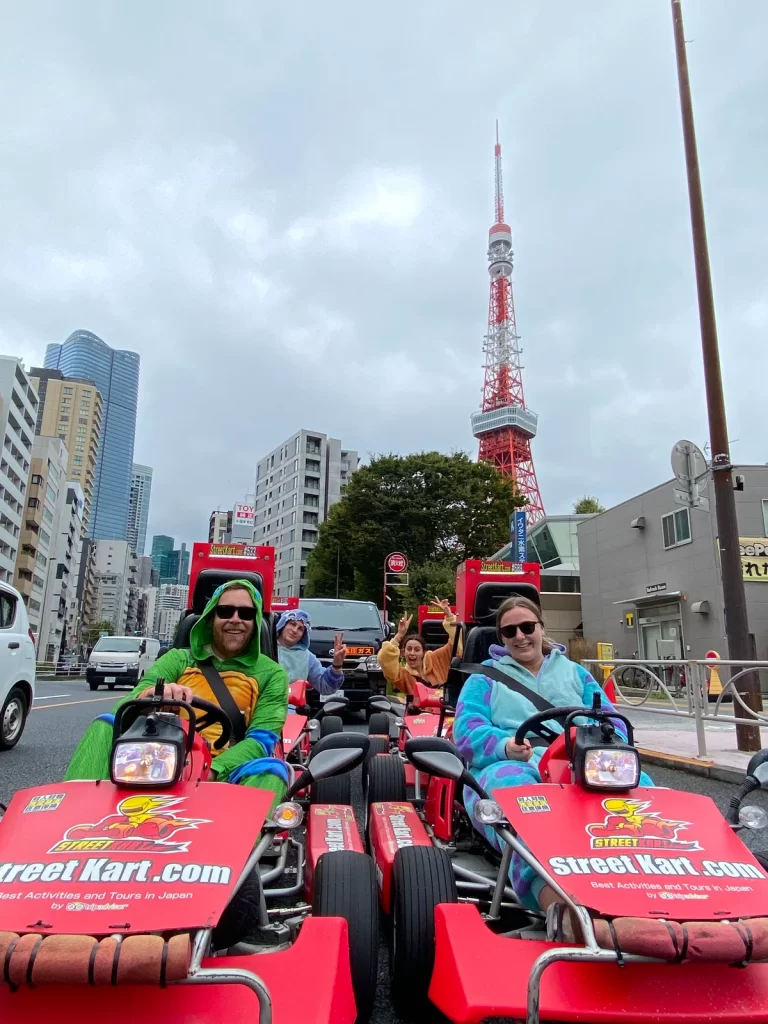
“Kono costume wa dou desu ka?” (How about this costume?) is helpful when selecting cosplay outfits provided during your street kart experience. Enjoy communicating with staff while choosing the perfect costume.
Cultural Experiences and Street Karting in Tokyo
Tokyo offers diverse cultural experiences, with street karting providing a uniquely modern way to explore traditional sightseeing destinations while enjoying contemporary entertainment.
You can tour iconic Tokyo landmarks like Shibuya’s Scramble Crossing, Tokyo Tower, and Asakusa’s Kaminarimon Gate by kart. Wearing cosplay costumes makes the experience even more memorable.
Understanding regional dialects and culture enriches your street kart experience. Interactions with locals become cherished travel memories.
Tokyo’s Diverse Cultural Zones
Each of Tokyo’s 23 wards has distinct characteristics. From luxury brands in Ginza and youth culture in Harajuku to traditional shitamachi atmosphere in Asakusa, unique cultures have developed in each area.
Touring these districts by street kart lets you experience Tokyo’s diversity in ways walking or train travel cannot match. Feeling the wind while driving makes each area’s distinctive atmosphere more vivid.
Tokyo is a city where tradition and innovation coexist. Experience the fusion of Edo-period culture with cutting-edge technology through street karting.
Important Notes
- Strictly observe traffic laws and drive safely
- Routes may change due to weather or traffic conditions
- Check the official website for the latest information before booking

