

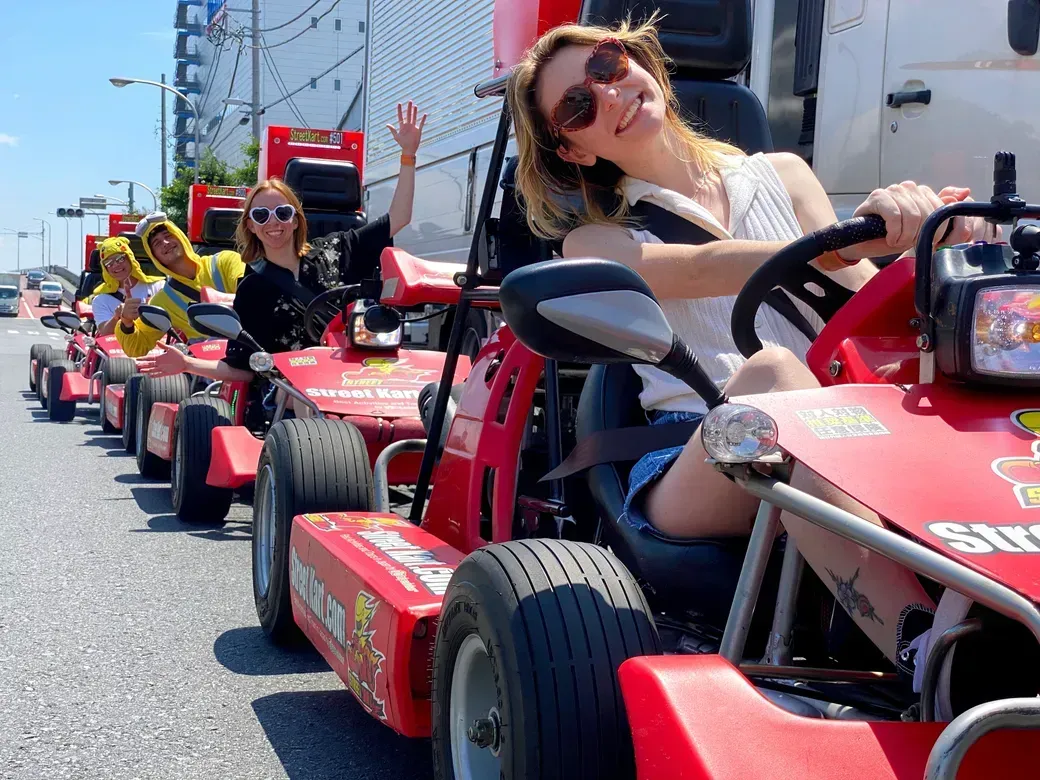
A Guide to Experiencing Tokyo’s Winter Scenery by Street Kart
Tokyo’s winter is a season when the air tends to feel relatively clear and the lights of the night leave a lasting impression. From tree-lined illuminations along the streets to the decorations of commercial facilities, waterfront vistas, and the architectural lighting of the city center, each area reveals a different face. For travelers who want to experience this seasonal urban scenery — including the act of moving through it — a street kart experience is well worth considering as one option for sightseeing in Tokyo.
A street kart experience is a guided tour-style activity that runs along public roads. Unlike walking or sightseeing from a vehicle window, it has the distinctive quality of letting you continuously feel the air of the city, the brightness of your surroundings, and the shifting scenery along the road. In winter especially, with seasonal decorations layered onto the post-sunset cityscape, many people find Tokyo’s night views all the more memorable.
In this article, we’ll lay out the points worth keeping in mind when considering a street kart experience in winter Tokyo, focusing on objective information. For confirmation of participation requirements and license details, please be sure to check the official website. Official information can be found at kart.st and on the license guide page at https://kart.st/en/drivers-license/.
Why Tokyo in Winter Is Easy to Sightsee
From December through February, Tokyo can have days where humidity drops compared to the summer months, making night views and distant scenery feel easier to take in. Of course, it depends on the day’s weather, but the clarity of the air can make the outlines of lights and the contrast of illuminated buildings stand out more vividly. Such seasonal changes become one element to enjoy when appreciating the cityscape of central Tokyo.
Winter is also the time when decorative lighting increases across many locations. Trees along major boulevards, station areas, commercial districts, and waterfront facilities often feature light displays, and even within Tokyo, the atmosphere shifts from area to area. Some places offer streetscapes with calm, subdued tones, while others feature lively streets where vibrant illuminations stand out. The fact that you can easily feel these differences while moving from one area to another is a charm unique to winter urban sightseeing.
In a street kart experience, since you travel along a set route on public roads, there’s a sense that the city’s expression switches from one moment to the next within a short span of time. Even within a range that would take significant time on foot, you can potentially enjoy the changing scenery efficiently as the tour progresses. Conversely, the way things appear and the time required vary depending on weather and traffic conditions, so the experience is never quite the same from one day to the next. Understanding it as an activity for savoring time on the ground — including these variables — makes it easier to grasp.
Basic Features of a Street Kart Experience
The Street Kart official website lists course information, booking pathways, and usage guidance for each location. Looking at the listings, Tokyo has multiple departure points, and the surrounding scenery and atmosphere of the journey vary depending on the departure location. The structure makes it easy to choose based on your travel itinerary or where you’re staying — a practical feature for inbound travelers.
The official site explains that this is a guided tour, provides estimates for the time required, and offers links to the booking page. For example, the guide for the Tokyo Bay location indicates a course of roughly 1.5 to 2 hours, though this can shift depending on traffic. Rather than picturing it as a quick one-off ride, it’s easier to think of it as an experience of taking in Tokyo’s scenery over a set period of time.
The official site also includes details about the meeting time and the flow on the day. There’s guidance about arriving roughly 30 minutes before your reservation time, the process of presenting required documents at check-in, baggage storage, and the pre-departure briefing — all the kinds of information you’d want to know before participating. This sort of advance explanation is important for first-time travelers trying to understand the flow.
If you’re participating in winter, you’ll need to prepare not only for the scenery but also for how you’ll feel temperature-wise. Because you’re traveling on public roads, there are moments when the wind feels stronger while moving than when stopped. Rather than prioritizing looks alone, it’s more practical to be conscious of clothing that combines mobility and warmth. Comfort levels vary from person to person, but it’s safer to prepare with the wind in mind, not just the air temperature.
Scenic Changes That Stand Out in Winter Tokyo
In winter Tokyo sightseeing, the impression of the city can change dramatically between day and night. During the day, the outlines of buildings and the sense of urban scale tend to be easier to take in, while at night the lighting tends to give the scenery along the road a more crisp, defined feel. If you’re considering a street kart experience during evening hours, a key feature is how easily you can sense this shift while in motion.
In central areas, the orderly streets of office districts, commercial facility lighting, and the way visibility opens up at each intersection change in continuous succession. Toward the bayside, bridges, waterfront views, broader road spaces, and the lights of distant building clusters often leave an impression. In areas closer to the older districts, you may notice a density of streetscapes and a sense of daily life that differs from large-scale development zones. Which scenery you prioritize will shape your preferred route.
The important thing is not to assume “you can see the same night view anywhere.” Courses differ by location, and the way things look as you pass through varies with traffic conditions. Whether specific facilities or street trees are illuminated may also change from year to year, so rather than holding firm expectations focused solely on illuminations, the closer-to-reality understanding is “enjoying the lit-up streetscapes of winter Tokyo while moving through them.”
For that reason, it’s more appropriate to receive it as an experience whose impression varies based on the day’s route, weather, traffic volume, and time of day, rather than thinking you can replicate exactly a single scene you saw in an article or on social media. Positioning it as an activity suited for travelers who want to experience seasonal urban scenery as part of their Tokyo sightseeing makes expectation management easier as well.
License Conditions to Confirm Before Participating
The most important thing to check when considering a street kart experience is the documentation required to drive. License requirements directly affect whether you can participate, so it’s more practical to confirm them before booking rather than later in your sightseeing planning.
The guidance on the Street Kart official website and on the license guide page at https://kart.st/en/drivers-license/ lays out information about licenses valid in Japan. The guidance breaks down the required conditions by category, including a Japanese driver’s license, an International Driving Permit based on the 1949 Geneva Convention, certain driver’s licenses from designated countries accompanied by an official Japanese translation, or SOFA-related documents for U.S. military-affiliated personnel in Japan.
What deserves attention here is that you cannot simply say “if you have an overseas driver’s license, you can participate.” The official guidance explains that whether a license is valid in Japan is not determined by passport nationality alone, but rather depends on the type of license or permit you hold. It also notes that Japan handles International Driving Permits strictly, and that formats accepted in other countries are not necessarily valid in Japan.
For that reason, prospective participants must check on a case-by-case basis, on the official page, the country of issue of their license, the type of license, whether translated documents are required, and any accompanying original documents needed. Especially with International Driving Permits, since differences in the underlying treaty can make a difference, it’s important not to judge based on the term “international license” alone. If there are deficiencies in the required documents, participation may not be possible, so it’s better to confirm well in advance, before your travel date.
Winter Clothing and Day-of Preparation
For a winter street kart experience, balancing warmth and ease of movement is essential. Tokyo’s winter isn’t an area with many snowfall days, but temperatures drop at night, and there are days when the perceived temperature feels lower. Especially while in motion you’ll feel the wind, so the temperature reading alone isn’t always a reliable indicator.
Rather than relying on a single thick layer, it’s more practical to use layered clothing that’s easy to adjust. If you separate your outfit into a long-sleeved inner layer, an insulating mid-layer, and a wind-resistant outer layer, it’s easier to adjust both indoors at the shop and during the ride. If you’re concerned about your hands or neck getting cold, gloves and a neck warmer can help. For footwear, it’s best to consider not only resistance to cold but also ease of movement while driving.
The official site notes day-of considerations, including the recommendation to avoid heels, sandals, and long skirts. This isn’t a matter of appearance — it should be understood as a basic condition tied to handling and safety considerations while driving. While you may be tempted to bundle up heavily in winter, it’s safer to avoid excessively long coats or clothing that restricts movement.
Time management is also important. The official guidance shows a flow of arriving roughly 30 minutes before your reservation time. Winter is also a time when transportation crowding and crowds around tourist areas can increase, so a travel plan with some buffer is appropriate. Especially if you’ve booked an evening session, if you’re heading directly from daytime sightseeing, calculating the walking time from the station to the shop in advance will help you participate with peace of mind.
How to Fit It Into Your Winter Tokyo Itinerary
Where you place a street kart experience within your day of Tokyo sightseeing changes the impression. If you visit museums, commercial facilities, or observation spots during the day and then add a moving experience while taking in the city’s lights at night, you’ll feel the changes a single city goes through depending on the time of day. Conversely, if you cram it into an arrival day or a day with a lot of moving around, check-in and preparation may feel rushed.
In winter, since the city’s lighting becomes more prominent from evening onward, those who prioritize night views will likely lean toward post-sunset time slots. However, availability for popular times and operational conditions may vary by season. When booking, it’s realistic to coordinate not only your preferred date and time but also the location you want to use, the travel time from where you’re staying, and your companions’ schedules.
For travelers, the fact that the act of moving itself becomes a sightseeing experience shouldn’t be overlooked. Tokyo has relatively distinct character by area, and the impression of the city can change just by going a few stations away. In a street kart experience, instead of passively watching this change from a seat, the meaning lies in being able to feel it as part of the tour’s progression. Things that are hard to convey through photos and videos alone — road width, surrounding brightness, the sense of distance from buildings — are elements of urban scale that are uniquely felt through on-the-ground experience.
Official Information Worth Checking Before Booking
For confirming bookings and participation requirements, each location’s page on the Street Kart official website, the booking pathway, FAQ, and access guide are useful. Since departure points and course information differ by location, rather than deciding solely based on proximity to your hotel, it’s better to consider compatibility with the scenery you want to see and your travel itinerary as well.
Regarding licenses, please prioritize the guidance at https://kart.st/en/drivers-license/ over general sightseeing information sites or individual experience reports. Originals of required documents may be a prerequisite, and whether translated documents are required varies by individual conditions. If you realize there’s a gap in your preparation only on-site, it can affect your entire itinerary, so it’s appropriate to confirm this part early.
Additionally, knowing the day-of flow, meeting time, items to bring, and clothing conditions based on the official guidance will help reduce day-of anxiety. In winter, since not just temperature but also rain and wind affect how you feel, checking the weather forecast before heading out and dressing appropriately is important.
Summary
Tokyo’s winter is a season in which the city’s lights tend to leave a strong impression in the clear air, making it an easy season to consider for travelers wanting to enjoy nighttime urban scenery. Within this, a street kart experience can be considered one means of sightseeing that lets you savor Tokyo’s streetscapes as continuous scenery — not merely a means of transportation. It has the distinctive feature of letting you feel the city’s sense of distance and atmosphere in a way that differs from both walking sightseeing and sightseeing from a vehicle window.
On the other hand, participation requires confirming license conditions, preparing necessary documents, and considering winter clothing. Especially for license-related conditions, since these are individual to each person, you must check the official information before booking. For details, please refer to kart.st and https://kart.st/en/drivers-license/. When planning winter Tokyo sightseeing, for those who want to value both seasonal scenery and the experience of moving through it, a street kart experience is one option well worth comparing and considering.
Regarding Costumes
Our shop does not offer rentals of Nintendo or “Mario Kart”-related costumes. We provide only costumes that respect intellectual property rights.
